

A Look at The 2025 Imo Economic Summit
By Uche Nworah Ph.D
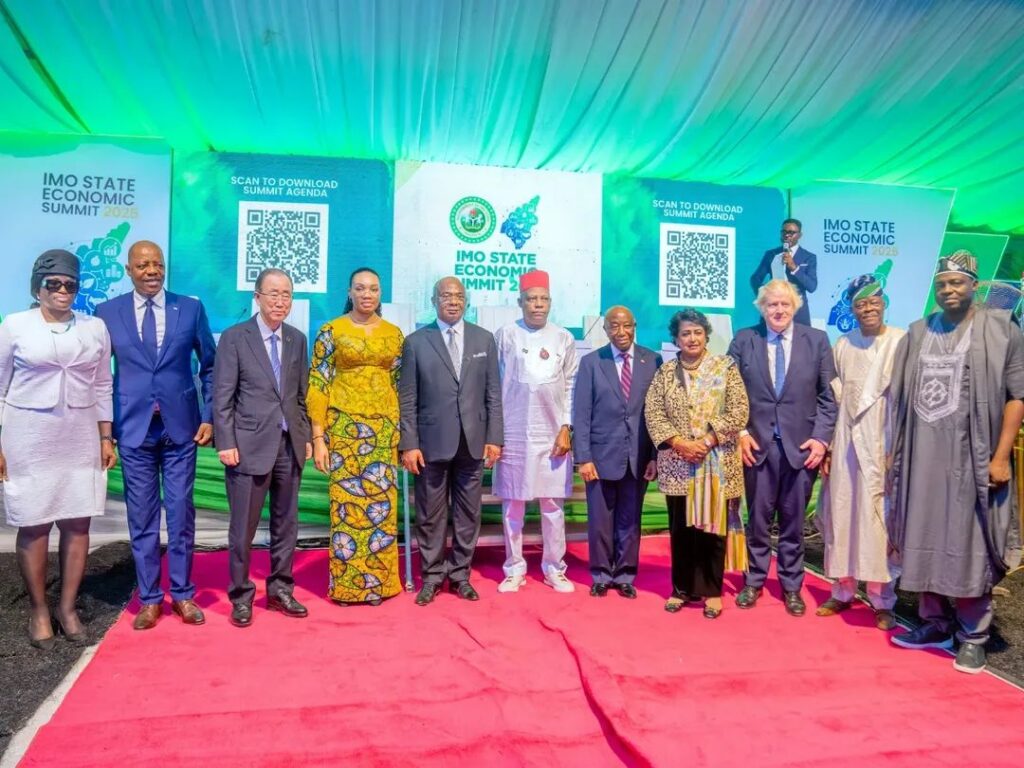
The 2025 Imo Economic Summit which held in Owerri on the 4th and 5th of December 2025, the state’s first full-scale economic summit was more than a high-profile conference. With its theme, “Unlocking Imo’s Economic Potential: Partnership, Investment, and Innovation,” it was a deliberate attempt by Governor Hope Uzodinma and the Imo state government to reposition Imo as a serious investment destination within Nigeria and West Africa.
Over two days, the summit brought together political leaders, global statesmen and major private-sector players – including Vice President Kashim Shettima, President of Liberia, Joseph Boakai; Former President of Mauritius, Ameenah Gurib-Fakim; Former UN Secretary-General, Ban Ki-Moon; Alhaji Aliko Dangote, President of the Dangote Group; Professor Benedict Oramah, former President of Afreximbank; Leo Stan Ekeh, Chairman, Zinox Technologies; Isha Sesay, former CNN anchor; Ernest Nwapa, and several other industry leaders. Traditional rulers and political figures including the Ooni of Ife, Oba Adeyeye Ogunwusi, and Eze Dr. Cletus Ilomuanya, Obi of Obinugwu, were also in attendance.
The speakers all converged around one message: Imo is open for business, and the world is invited.
Governor Uzodinma: Rebranding Imo as “Investment Meets Opportunities”
Governor Hope Uzodinma used the summit to reintroduce Imo to investors, not as a civil-service state but as a resource-rich frontier for capital. He highlighted the state’s natural endowments and reforms, stressing that Imo has deliberately worked to reduce risk for investors. In his remarks, he pointed out that “we are blessed with the largest gas reserves estimated at 200 trillion cubic feet… Imo State is the destination” for those seeking opportunities in gas exploration and utilisation.
Beyond gas, Uzodinma listed other mineral and agricultural resources – lead, zinc, crude oil, cotton and strong human capital – and emphasised that the state has created a friendlier business environment. As he put it, “Imo is blessed with huge resources, and government has provided favourable conditions that investors cannot resist… Imo is now a one-stop shop for investment.”
By coining Imo as a place where “Investment Meets Opportunities (IMO)”, Uzodinma tried to brand the state itself as a product – a strategic move that, if backed by consistent policy, could shape investor perception for years.
Vice President Shettima: From Rhetoric to Measurable Outcomes
Vice President Kashim Shettima’s contribution framed Imo within Nigeria’s broader diversification agenda. He described the state as “a major pillar” in the country’s economic diversification drive, especially in technology, gas utilisation, agro-industrial processing and SMEs.
Shettima’s most important takeaway was his insistence that national growth depends on each state taking responsibility for its own development. As he put it, “Nations rise when every part discovers its promise and takes responsibility for its own economic direction.” This directly challenges Imo’s leaders and private sector to move beyond talk into sustained execution.
He also offered investors reassurance about policy and federal backing, noting that the Federal Government stands ready to “de-risk promising ventures” in Imo through institutions such as the Bank of Industry and the Development Bank of Nigeria, as well as structured public-private partnerships in housing, transport and renewable energy.
Crucially, Shettima warned against allowing the summit to end as a talk shop: “Let this Summit not end with good ideas alone. Let it lead to signed partnerships, funded projects and measurable outcomes that uplift lives and create jobs.” That line is a direct challenge and also a clear benchmark against which Imo’s leaders can later be judged.
Aliko Dangote: “We Will Be One of Your Biggest Investors”
For many participants, the strongest endorsement came from Aliko Dangote. Known for backing his words with billion-dollar projects, he used the summit to advocate for Africans investing “at home.” Explaining why he continues to scale up his businesses on the continent, he said: “I don’t have anywhere else to go and invest but at home,” clarifying that by “home” he means Nigeria and Africa.
Dangote linked sustainable growth to reliable power, insisting that “there can never be growth without power,” while commending Uzodinma’s 375-megawatt electricity initiative for Imo. He then went further with a direct pledge, assuring the governor that Dangote Industries “will be one of your biggest investors in Imo.”
If followed through, such a commitment could unlock large-scale investments in sectors like fertiliser, cement, logistics or energy, with massive implications for job creation, industrialisation and internally generated revenue in Imo.
Boris Johnson: Confidence in Nigeria’s Safety and Potential
Boris Johnson’s intervention mattered less for capital commitments and more for global perception. Speaking at the summit, he framed Nigeria as the next big destination for investors, stating that “Nigeria has phenomenal potential growth.”
Johnson also tackled head-on the issue of security, acknowledging that he arrived in the country after hearing many negative stories. Yet, his verdict after visiting was positive: “I came with all the stories of security challenges… I am happy with what I have seen in Imo State.”
Coming from a former UK Prime Minister, such remarks serve as soft power – a reputational boost that can help counter balance the often one-sided global narrative about insecurity in Nigeria and the South-East. That kind of endorsement can make cautious foreign investors more willing to at least look at Imo’s data room and project pipeline.
Concrete Economic Prospects for Imo State
Taken together, the messages from Uzodinma, Shettima, Dangote and Johnson point to several concrete economic benefits that can flow from the summit if its resolutions are implemented.
- Energy and Gas Industrialisation
With what officials describe as Nigeria’s largest on-shore gas reserves, Imo is well-positioned for gas-based power plants, petrochemical projects and gas-to-industry schemes. Uzodinma’s emphasis on 200 trillion cubic feet of gas, combined with Dangote’s appetite for large-scale industrial investments and his focus on power, suggests that gas could become the backbone of a new industrial corridor in the state. - Export Capacity and Special Economic Zones
Afreximbank’s Benedict Oramah disclosed that the bank is already building a multimillion-dollar facility in Imo to support the production and export of globally compliant goods. Coupled with proposed free trade zones and special agro-industrial processing zones highlighted by Shettima, this could transform Imo into a manufacturing and export hub for agro-processed products, light manufacturing and services. - SMEs, Tech and the Digital Economy
Shettima identified technology and SMEs as central to Imo’s future, calling for strong digital infrastructure and support for young innovators. If the state follows through with incubators, broadband expansion and targeted financing, the summit could catalyse a tech-enabled SME ecosystem that keeps young talent in the state rather than losing them to Lagos, Abuja or overseas. - Agriculture and Agro-Processing
Imo’s arable land, palm plantations and agro-industrial potential were repeatedly mentioned in pre-summit and summit communications. With better logistics, storage, processing facilities and access to export markets, agriculture could shift from subsistence to a higher-value, value-chain-driven sector, providing rural jobs and raising incomes. - Tourism, Hospitality and Services
With improved security and infrastructure – roads, power, and the branding of Owerri as a safe host of a global summit – Imo can deepen its existing reputation as a hospitality centre while moving into higher-value tourism products such as conferences, eco-tourism and cultural events. - Institutional and Policy Reforms
Perhaps the most important benefit is less visible: improved governance. The summit repeatedly linked investment attraction to credible reforms, from ease of doing business to dedicated growth and development funds designed to crowd in private capital. If Imo institutionalises these reforms – rather than tying them to one administration – it can lock in investor confidence over the long term.
Conclusion: The Real Test Starts After the Cameras Leave
The central takeaway from the 2025 Imo Economic Summit is that Imo successfully put itself on the investment map and secured strong verbal commitments from both global and domestic heavyweights. Uzodinma showcased a state rich in gas and human capital, Shettima framed Imo as a new growth frontier backed by federal reforms, Dangote signalled readiness to be “one of your biggest investors,” and Boris Johnson publicly affirmed Nigeria’s safety and potential for phenomenal growth.
However, the summit’s true economic value will not be measured by speeches or photo-ops, but by what follows: signed deals, ongoing construction sites, operational factories, exporting firms, empowered SMEs and thousands of new jobs. In Shettima’s words, Imo must now ensure that this summit leads to “measurable outcomes that uplift lives and create jobs.”
If the state can convert the momentum of December 2025 into sustained reforms and concrete projects, the Imo Economic Summit will be remembered not just as a landmark event, but as the moment when Imo genuinely became the place where investment meets opportunities.
Smart Chukwuma Amaefula may have captured the general mood of Ndi Imo and friends of Imo State with his comment on Facebook; “I’m a strong critic of Hope Uzodinma, but you see this summit he pulled. I support him 100% and applaud him for what he achieved for Imo State with this summit”.
(Dr. Uche Nworah who was in Owerri for the summit is the Founder/President of Abuja-based Charlton Business School)