


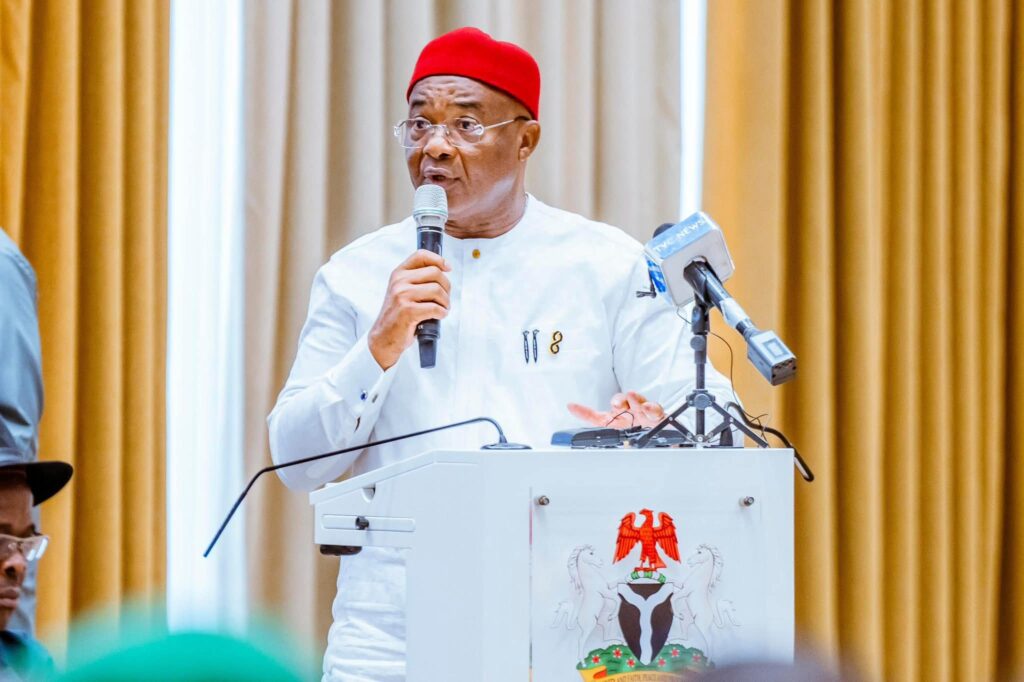
11th Senate: Why Uzodinma is Throwing His Hat In The Ring
Though the trend has been that governors who are completing their second terms run for Senate seats, the eagerness shown by Governor Hope Uzodinma of Imo State to return to the Red Chamber of the National Assembly has remained unrivaled.
The governor who obtained forms to contest the Imo West Senatorial District appeared for screening before the committee over the weekend.
With that he becomes the only governor whose tenure is not ending in May 2027 but is already neck deep into seeking another elective office.
Unlike his colleague second term governors like Mai Mala Buni, Dapo Abiodun, Abdullahi Sule whose tenure expire May 29, 2027, etc Uzodinma’s current term as governor runs till January 15, 2028 as Imo falls within the circle of states that have their governorship election off the general season.
Analysts say what it means is that if he wins in the January 2027 elections, he’ll have to quit Imo Government House in June of the same year when the 11th Senate would be inaugurated which is a clear six months to when his tenure as governor would end.
Our correspondents observe that this would be the first time in the current dispensation that a governor would forfeit a part of his tenure in order to run for another one.
Analysts recall that the only incident close to that was when then governor of Abia State, Orji Uzor Kalu vacated his seat four days before the official winding up of his tenure to swear in he successor, Theodore Orji.
What others interested in vying for other positions have been doing ahead our correspondents note, was to place what they call a place holder, who will occupy the seat until their tenures expire, then such persons would resign from the seat to pave the way for their elections.
Why the interest
Analysts say the Imo Governor may have chosen a different path not just because the other route is longer but because he is eyeing the presidency of the 11th Senate.
The calculation out there is that if President Bola Ahmed Tinubu wins the 2027 elections for a second term, it is likely that that seat of the Senate President would go either to the South South or South East due to the fact that both the President and the Vice President are Muslims and would be expected to choose the number three person from a predominantly christian zone.
But the question is, what must have assured the governor that he would be elected Senate when the current one, Godswill Akpabio is also interested in returning to the seat?
A source who does not want to named told our correspondent that since David Mark has set a precedence by returning to the Senate to continue as President of the Senate in 2011, Akpabio, given his closeness to President Bola Ahmed Tinubu, would want to replicate same.
Presidency sources however indicate that having shown more than an average enthusiasm in the Tinubu re-election project, Uzondinma is seen as more aggressive in handling political issues.
“He is a two time senator and has experience and his presence would give the Southeast a sense of belonging” a source told our correspondent.
The Imo governor for instance is the Director-General and National Coordinator of the Renewed Hope Ambassadors (RHA), an organization specifically for the promotion of President Bola Tinubu’s Renewed Hope Agenda. He is also the chairman of the Progressives Governors Forum where he presides over the meeting of 30 of his colleague governors in the same party.
Meanwhile efforts to get the reaction of the Presidency on the development was not successful, as Mr. Bayo Onanuga, Special Adviser to the President on Information and Strategy could not be reached for comment.
Also, Dr Daniel Bwala, the Special Adviser to the President on Policy Communications’ phone was not unreachable.
Uzodinma represented the Imo West Senatorial District from 2011 to 2019 under the Peoples Democratic Party (PDP) before joining the All Progressives Congress (APC).
The obstacles before the governor
In a move believed to be designed to stop Uzodinma from contesting the Senate Presidency, the Senate last week attempted to modify Order 4 and 5 to of its rules to provide that only senators who served the immediate preceding term could contest for principal offices. It was however reversed following intense criticisms..
In another move believed to be aimed at clipping his wings, some APC governors attempted to remove him as chairman of the PGF.
Director-General of the forum, Folorunso Aluko, in a statement on Friday, said the reports of Uzodinma’s removal were fake and misleading.
‘Why I’m going to the Senate’
The Governor explained that his decision to contest the seat is to serve his people and President Tinubu.
He stated on his X handle shortly after screening that, “My dear people of Imo West Senatorial District have once again called upon me to serve, and I have accepted this noble call with utmost humility, sincerity of purpose, and unwavering commitment to the collective advancement of our people,” he wrote.
“During the engagement, I reaffirmed that the Senatorial seat I seek to occupy belongs first and foremost to our great party, while I remain only a loyal and dedicated candidate entrusted with the responsibility of projecting and advancing the ideals, vision, and aspirations of the APC to the very best of my ability,” he stated.
He added that his aspiration was inspired by the desire to support President Bola Tinubu’s administration through “quality representation, effective legislation, enhanced development, and sustainable progress.”
No constitutional barrier to Uzodinma’s Senate ambition – Constitutional lawyer
A Kano-based constitutional lawyer, Barrister Umar Usman Danbaito, said Nigeria’s presidential system of government does not permit an individual to simultaneously occupy executive and legislative positions.
He stressed that while Governor Uzodinma has the constitutional right to contest for a Senate seat, he cannot hold both offices at the same time.
On whether the move raises constitutional concerns, Danbaito was categorical: “Legally speaking, there is no problem. If immediately after his election, before swearing in, he resigns as governor, there is no constitutional impediment against that.”
However, he raised questions about the moral dimension of such a decision. According to him, governors should not use their incumbency to edge out party members or deny them opportunities to contest.
“Morally speaking, the executive governor should allow his subjects to contest other elections. He should not be seen using his power to the detriment of his party members,” he argued.
Danbaito lamented that Nigerian politicians often prioritize personal ambition over collective interest.
Another commentator Salman Jawondo a Senior Advocate of Nigeria (SAN) said there is no legal barrier stopping a sitting governor from contesting for a Senate seat while still in office.
Jawondo said the Nigerian Constitution does not prohibit elected office holders from seeking another elective position before the expiration of their tenure, stressing that issues surrounding such moves are more moral than legal.
“No, they cannot stand as a voter or be voted for at the primaries of a political party. That’s what the law says for appointed officials. But elected people are different,” he said.
He explained that governors contesting for Senate seats are in a similar position to governors seeking re-election or other elective offices, noting that they are not required to resign before participating in elections.
The senior lawyer further explained that a governor only forfeits his office after taking the oath of office for another position, adding that until then, such a governor legally retains his seat.
“You know one thing, he will not even resign until he takes the oath of office for another office. It is only when he is sworn in at the Senate level that he forfeits his seat as governor,” he said.
Jawondo, a former Attorney General and Commissioner for Justice in Kwara State, added that a governor seeking to become Senate President even has a strategic advantage because the election of presiding officers of the National Assembly takes place immediately after inauguration.
“If he gets elected as Senate President, he is then sworn in as senator and Senate President. That is when he forfeits his seat as governor. But if he does not get elected as Senate President, he can still return to his seat as governor,” he explained.
Drawing from past political developments, the former attorney general referenced the case of former Senator Udoma Udo Udoma during the administration of former President Olusegun Obasanjo, saying the former lawmaker underwent ministerial screening but declined to take the oath of office after reportedly being dissatisfied with the portfolio assigned to him.
On the moral implications of governors seeking legislative offices immediately after serving in executive positions, Jawondo said the trend reflects the deeper crisis within Nigeria’s political culture, where public office is increasingly viewed as a means of personal survival rather than public service.