


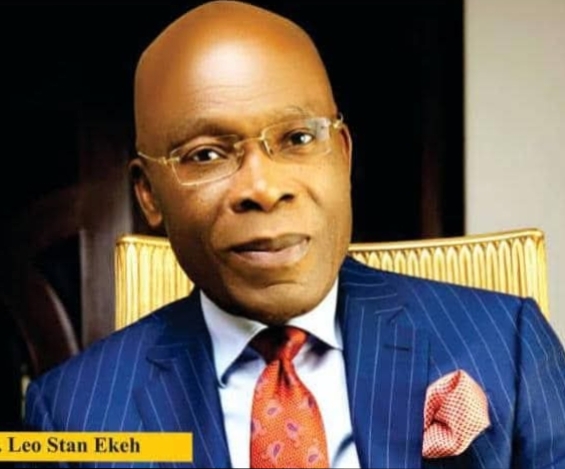
Leo-Stan Ekeh @70: The Man, His Impact And His Legacy
By Ik Ogbonna, PhD
From Ubomiri to the frontiers of Africa’s technology revolution, the story of Leo Stan Ekeh is ultimately a story about faith, courage, enterprise and people.
There are people who become successful.
There are people who become influential.
And then there are those whose success begins to create opportunities for people they may never meet.
Leo Stan Ekeh belongs to the third category.
At 70, the Chairman of Zinox Group can look back on more than three decades of building businesses, pioneering technology, creating jobs, supporting entrepreneurs and, increasingly, investing directly in the education and digital future of young Nigerians.
But perhaps the most fitting description of the man did not come from a business magazine or a corporate biography. It came from former President Olusegun Obasanjo.
On October 1, 2001, Obasanjo, then President of Nigeria, honored Ekeh as an “Icon of Hope” for his pioneering efforts in information technology and his contribution to Nigeria.
Twenty-five years later, that description appears to have acquired an even deeper meaning.
When Obasanjo visited Ekeh during his 70th birthday celebrations in February 2026, he described him as “a very kind man, an achiever” and spoke about the impact Ekeh had made at a critical period in Nigeria’s information technology history.
Those words: “Icon of Hope”, “kind man”, “achiever” capture three different dimensions of Leo Stan Ekeh.
The pioneer.
The entrepreneur.
And the humane being.
THE BOY FROM UBOMIRI
There was a young boy from Ubomiri in Mbaitoli Local Government Area of Imo State.
Born on February 22, 1956, Ekeh grew up in a family that valued education, discipline, faith and enterprise. He attended Holy Ghost College, Owerri, and has spoken about his early years as a mass servant and chorister.
Those humble beginnings are important because Ekeh’s story has never really been about where he started. It has been about what he chose to do with what he was given. As a young man, he travelled to India, where he studied Economics at Punjab University. He later pursued further studies in risk management at Nottingham University in the United Kingdom. Exposure to different societies and economies broadened his understanding of what technology could mean for developing countries. He returned to Nigeria with something more valuable than a certificate. He returned with a vision.
THE DECISION THAT CHANGED EVERYTHING
In the late 1980s, information technology was still largely unfamiliar territory in Nigeria.
Computers were expensive. Digital infrastructure was limited. And the idea of building a major indigenous technology company in Nigeria was anything but obvious.
But Ekeh decided to try.
He established Task Systems, initially focusing on desktop publishing and computer graphics. The company became involved in helping transform aspects of Nigeria’s publishing, printing and advertising industries. That was the beginning. What followed was not one company, but an ecosystem.
Technology Distributions.
Zinox Technologies.
Other technology ventures.
And eventually Konga.
Ekeh became one of the entrepreneurs who helped move Nigeria from being predominantly a consumer of imported technology towards becoming a country capable of building, distributing and deploying technology at scale.
BusinessDay Newspaper once described him as an entrepreneur driven by the desire to use technology to transform people’s lives. That description perhaps explains his journey better than the list of companies ever could. For Ekeh, technology was never supposed to be just about machines. It was about possibilities.
BUILDING AN INDIGENOUS TECHNOLOGY GIANT
With the establishment of Zinox Technologies in 2001, Ekeh’s ambitions became more visible.
Zinox emerged as an indigenous technology company at a time when the Nigerian ICT industry was heavily dominated by foreign brands. Its development of locally assembled and manufactured computer systems became an important statement: Nigerians could participate in the production of technology, not merely its consumption. The company later became involved in major national technology projects, including voter-registration exercises.
Ekeh also expanded his interests across the technology value chain, creating a wider business ecosystem around ICT distribution, solutions and digital commerce. His acquisition of Konga in 2018 added another significant chapter to that story. Today, the Zinox Group remains one of the best-known indigenous names associated with Nigeria’s technology industry.
And Ekeh’s influence has extended beyond the companies he founded. He has become part of the story of Nigeria’s digital transformation itself.
BUT THEN SOMETHING CHANGED
Perhaps the most interesting part of Leo Stan Ekeh’s story is what happened after he had already achieved considerable business success.
He began to give more attention to the question:
What happens to the young Nigerian who has talent but lacks opportunity? That question appears to have increasingly shaped his philanthropy. And this is where the businessman begins to reveal the humanist.
Ekeh has supported education, entrepreneurship and technology access for years. The Leo Stan Ekeh Foundation has undertaken interventions across educational institutions, including entrepreneurship training, technology donations and support for young people. The Foundation says its programmes have reached thousands of beneficiaries over the years.
The emphasis is not simply on charity. It is on capacity. Teach someone. Give them a tool.
Connect them to the internet. Expose them to technology. Give them a chance. And allow them to build something of their own.
That is a different philosophy from simply handing someone money. It is an investment in human potential. In four decades, he has trained over 6,000 young people across the nation.
1,000 YOUNG NIGERIANS: A 70TH BIRTHDAY GIFT
This philosophy became particularly visible around Ekeh’s 70th birthday.
Instead of allowing the milestone to be remembered only for the celebrations surrounding it, his Foundation and companies associated with him announced a major technology scholarship initiative targeting 1,000 Nigerian students from indigent backgrounds.
The programme is designed to support young Nigerians studying technology-related disciplines, including Computer Science and Computer Engineering, with the stated ambition of developing future technology leaders, innovators, engineers and entrepreneurs.
There is something deeply personal about that gesture.
At 70, a man who built his first technology business when Nigeria’s technology ecosystem was still in its infancy is helping another generation enter that same field. He is, in effect, passing the baton. The young Nigerian who receives that scholarship may never sit across a table from Leo Stan Ekeh. But years from now, that young person could become a software engineer.
A professor.
A researcher.
A technology entrepreneur.
An AI specialist.
A job creator.
And somewhere in that story, there will be a scholarship that made the first step possible. That is how legacy works.
FROM ICT CENTRES TO AI CENTRES
And Ekeh’s intervention has not remained stuck in the technology of yesterday. The world has moved from basic computer literacy to artificial intelligence, and his philanthropic interventions are moving with it.
In 2026, the Leo Stan Ekeh Foundation donated an Ai Technology Centre to Holy Ghost College, Owerri, his alma mater and recently at Gbagada Grammar School, Lagos and across the country. The centers include computers, AI-enabled interactive technology, solar-powered infrastructure and Starlink connectivity. There is something particularly touching about that intervention.
The boy who once walked through the gates of Holy Ghost College returned decades later with the technology of the future. He did not simply come back to tell the students how successful he had become. He came back with tools.
“Here is what you will need for your own journey.”
That is a different kind of giving. And the interventions have extended beyond Imo to the rest of the country.
The message is unmistakable: Nigeria’s children must not merely be consumers of the Ai revolution. They must be participants in it.
WHY OBASANJO’S “ICON OF HOPE” STILL RESONATES
When Obasanjo called Leo Stan Ekeh an “Icon of Hope” in 2001, Nigeria was at a very different point in its technological journey. Today, that description resonates differently. Hope is no longer simply about what one entrepreneur has achieved. It is about what his achievements make possible for others.
A scholarship.
A computer laboratory.
An Ai Centre.
An internet connection.
An entrepreneurship programme.
A young person discovering that technology can be a career.
A student who realises that poverty does not have to determine the limits of his or her ambition.
That is why Obasanjo’s more recent description of Ekeh as “a very kind man, an achiever” is significant.
The two descriptions—Icon of Hope and kind man, an achiever—tell a fuller story.
One speaks about his public impact.
The other speaks about the person behind the impact.
AN IMO GIFT TO NIGERIA AND THE WORLD
Leo Stan as his friends fondly call him was given an awarded by Forbes as “Best of Africa Leading Tech Icon” and regarded as “Africa’s foremost serial disruptive digital entrepreneur”.
For Imo State, Leo Stan Ekeh’s story carries another layer of meaning. He is one of its sons who travelled beyond the state’s boundaries and returned with something to give.
His roots remain in Ubomiri.
His educational journey took him beyond Nigeria.
His businesses grew across Nigeria and Africa.
His technology partnerships connected him to the wider world.
But increasingly, his philanthropic investments are finding their way back to schools, communities and young Nigerians.
That is why the description of him as “Imo’s gift to the world” resonates with many people who identify with his journey. But perhaps there is an even more human way to say it:
Imo gave Nigeria Leo Stan Ekeh. Leo Stan Ekeh is now giving Nigeria a generation.
THE LEGACY IS NO LONGER JUST ABOUT ZINOX
At 70, it would be easy to define Leo Stan Ekeh by the size of his business empire. That would, however, tell only part of the story.
The companies are important.
The technology is important.
The jobs are important.
The investments are important.
But there is another measurement of success that does not appear on a balance sheet.
How many people became better because you passed through their lives?
How many young people received an opportunity?
How many students encountered technology for the first time?
How many entrepreneurs received a push when they needed one?
How many institutions acquired technology they could not otherwise afford?
How many people were encouraged to believe that they could build something?
These questions may ultimately define the Ekeh legacy more than corporate numbers.
LEO-STAN AT 70
There is a beautiful symmetry in Leo Stan Ekeh’s journey. A young Nigerian left home to acquire knowledge. He returned and built businesses around that knowledge. Those businesses helped shape Nigeria’s technology landscape.
And now, at 70, he is investing in ensuring that another generation acquires the knowledge and tools necessary to shape the future.
That is the journey:
From Ubomiri to the world.
From computers to artificial intelligence.
From entrepreneurship to philanthropy.
From building companies to building people.
And perhaps that is why the words of former President Olusegun Obasanjo remain so fitting.
“Icon of Hope.”
“A very kind man.”
“An achiever.”
Three descriptions. One life. And a legacy that is still being written.
At 70, Leo Stan Ekeh is not simply celebrating how far he has travelled. He is, perhaps more importantly, asking how many young Nigerians he can help travel farther. That may be the most enduring legacy of the man from Ubomiri.
Ik Ogbonna PhD is a University Lecturer and PR Practitioner.
+2348037203559